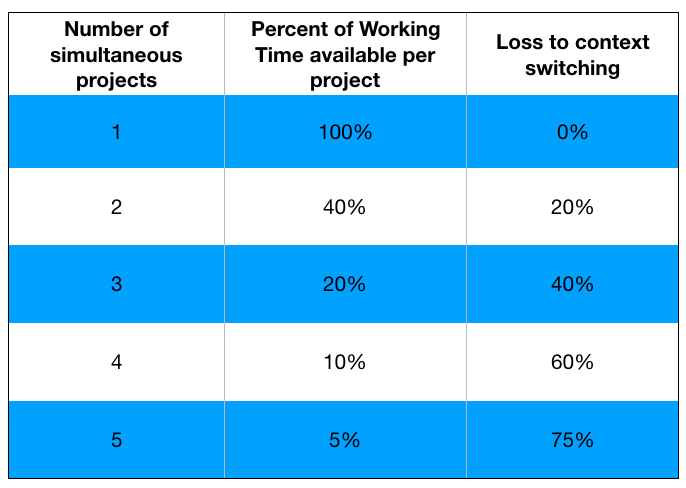
On his table, Weinberg (1992) tried to quantify the time lost “jumping” within projects. A lot of researches show and affirm that multitasking kills efficiency.
Weinberg table of project switching waste
Unfortunately, in nowadays world, is impossible to do one thing at the time so how to be efficient while managing several projects?
First we must set up a methodology that will help us to gather information as soon as possible on the Projects, so we will need to spend more time on the initial phases of the project (analysis and planning). Then we should try to have smaller teams, more focused on fewer projects, that will help the team members to collaborate more, learn more and be quicker on delivering. Most of the times the ability of multitasking is considered a great skill, do you think so?
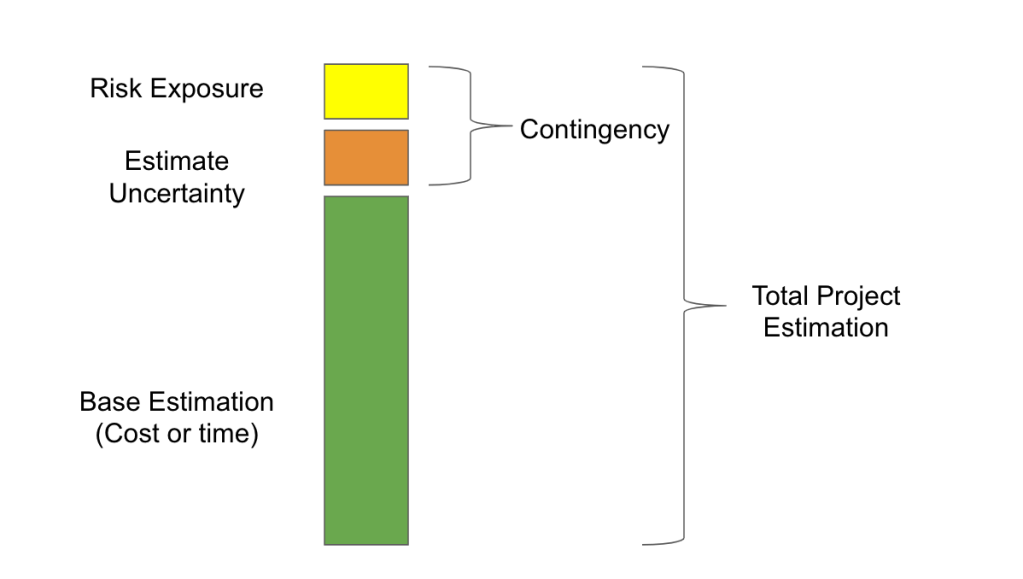
That is a term widely used in project management, most of the time misused to justify a not well done planning or analysis. In project management Contingency is generally (and wrongly) used when talking about Times (when duration is uncertain) or Costs (the famous “safety bearings” to absorb some cost oscillation).
Actually that usage of Contingency is not correct, in fact it is a tool, and must be used as a tool, to manage risk.
The project total estimation
Contingency is about a risk we have already found, analyzed and assessed for which we decided to not do any pro-active action, but just hope for that risk to not happen. So the only action undertaken for that risk is to take into account that risk and that could bring to longer times or (and) higher costs.
The contingency must be taken into consideration in the budget estimation, it has to be always explicated and not be confused with some rounding of costs and times.
Evaluation apprehension is one of the two main problems and pitfalls in idea generation within groups, along with Production blocking.
Let take the example of a team doing a brainstorming about developing a new car focusing on different domains: chassis, engine, design, and steering.
Person D shares an idea from his or her own domain, the steering of the car. Now, Person C was thinking about the design and wanted to share a radical but risky idea, Person C now thinks maybe, “my idea is not as good as the idea about the steering.”
Maybe we should just focus on steering and not on design, he or she then only shares ideas that fit what is already there. In other words, this person is afraid to share his or her ideas because he or she fears to be negatively evaluated: This is really harmful for creativity.
The ideas that are not mentioned are often the most unique.
We do not want to be negatively evaluated and that we might be if we come up with a weird idea. The consequences of evaluation apprehension are very bad, because, if unique ideas are not shared, we only get similar ideas in a group. This is problematic because we want a lot of different ideas. So, we can combine the best ones.
There are a lot of useful tools that can be used to prevent Evaluation Apprehension. I’ll discuss them in others Pills.
Generating ideas is not easy, especially in teams. Even if it is been proved that teams are more creative than individuals, there are some pitfalls related to idea generation within teams.
Lets take the example of a team doing a brainstorming about developing a new car focusing on different domains. Chassis, engine, design, and steering. What happens when a team member shares his or her idea, for instance, on the steering of the car? Person A was generating ideas about the chassis. But, he gets interrupted by Person D who shares his or her idea on the steering. The consequence is that Person A starts thinking about the steering of the car instead of of the chassis and eventually, everybody is looking to steering and we may miss a lot of good ideas concerning chassis, engine, or design. This is very likely to happen. Research on this process, which is called production blocking, shows this process is very harmful it diminishes the amount of ideas as well as the quality of those ideas that a group generates.
There are a lot of useful tools that can be used to prevent Production Blocking. I’ll discuss them in others Pills.
Before talking about SCAMPER in idea generation and mangament, some background: The invention of SCAMPER (or S.CA.M.P.E.R.) is attributed to Bob Eberle, but (as you can read on Wiki) SCAMPER was proposed by Alex Faickney Osborn in 1953 first, and was further developed by Bob Eberle author of books about creativity for children aimed at teachers. His book Scamper is out of print but a follow-up Scamper On is available.
Today’s pill is about idea generation/management and innovation. Scamper is one of the most famous and used methodologies in the area, but what is it?
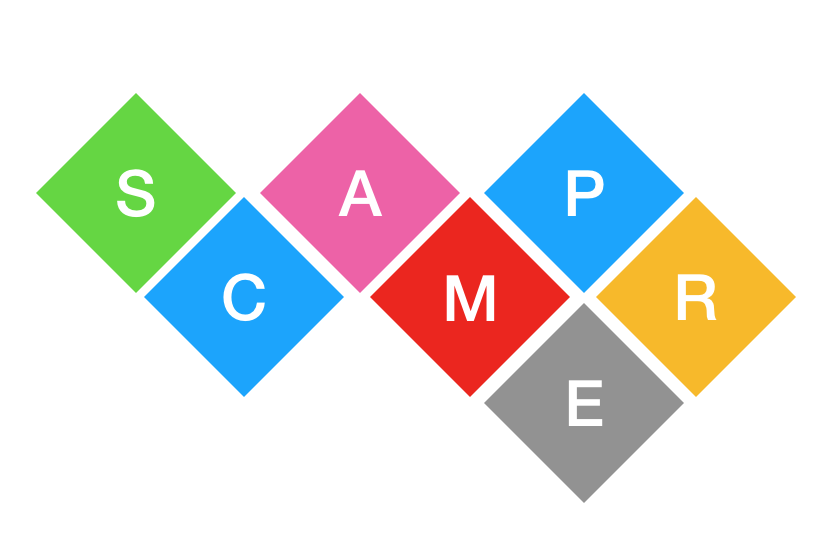
S.C.A.M.P.E.R is an acronym and stands for:
SSubstitute
Remove some part of the accepted situation, thing, or concept and replace it with something else.
CCombine
Join, affiliate, or force together two or more elements of your subject matter and consider ways that such a combination might move you toward a solution.
AAdapt
Change some part of your product (or thing in general) so that it works where it did not before.
M Modify
Consider many of the attribute of the thing you’re working on and change them, arbitrarily, if necessary. Attributes include: size, shape, other dimensions, texture, color, attitude, position, history, and so on.
P Purpose (Put to other use)
Modify the intention of the subject. Challenge all of these assumptions and suggest new and unusual purposes.
E Eliminate
Arbitrarily remove any or all elements of your subject, simplify, reduce to core functionality
R Reverse
Turn it upside-down, inside-out, or make it go backwards, against the direction it was intended to go or be used.
R Rearrange
Similar to Reverse, modify the order of operations or any other hierarchy involved.
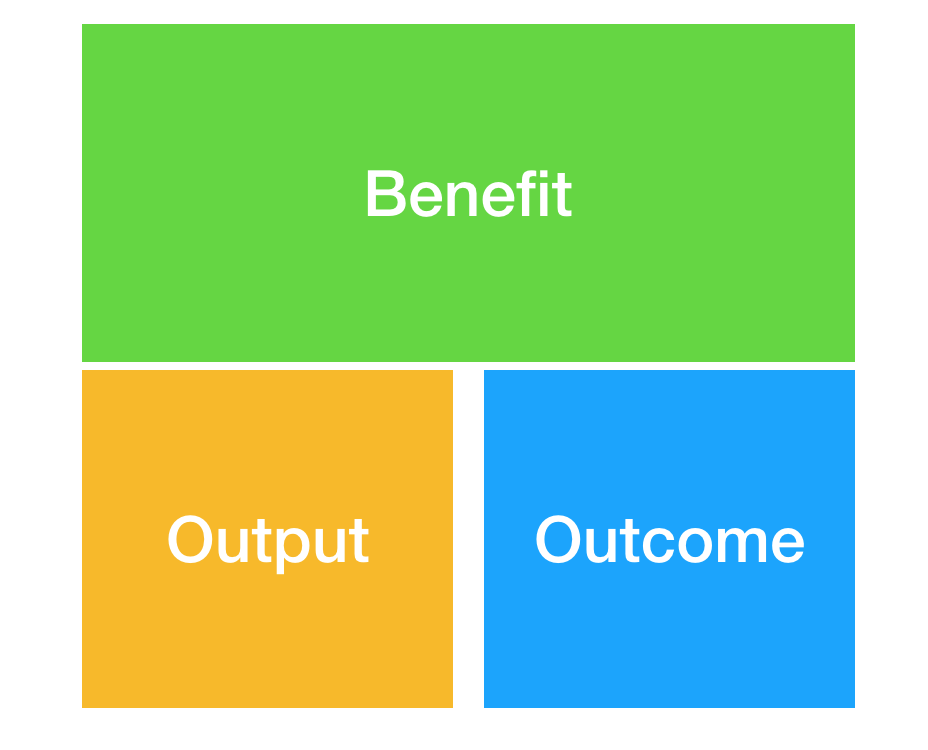
It is always a hot topic, especially in project management: what is the difference between Output, Outcome and Benefit? Let’s talk about these three things we all hear about everyday.
The Output (in PM world, the deliverable): that is the thing that is created/delivered with the project
The Outcome: that is the performance reached using the Output.
The Benefit: this is actually why we started the project, the reason why we invested time and money on the project.
The definitions can seem a little confusing but actually they are crucial and they help to clarify the accountability of the PM (for the Output) and Sponsor (for the Benefit), if the both actors take their responsibility there will be a win-win situation.



 Innovation & Project Management Pills